
2 Comments

Off the Dome( Guest Article by Allison Elshoff)

“You are here.”

The words hang in the air. I close my eyes as a blanket of quiet settles over the space. All the tension in my shoulders unfurls as the room takes a collective sigh. It’s 5 p.m., and for the first time that day – between the blur of classes and meetings and office hours – I do feel unequivocally, positively here. 

It feels great.

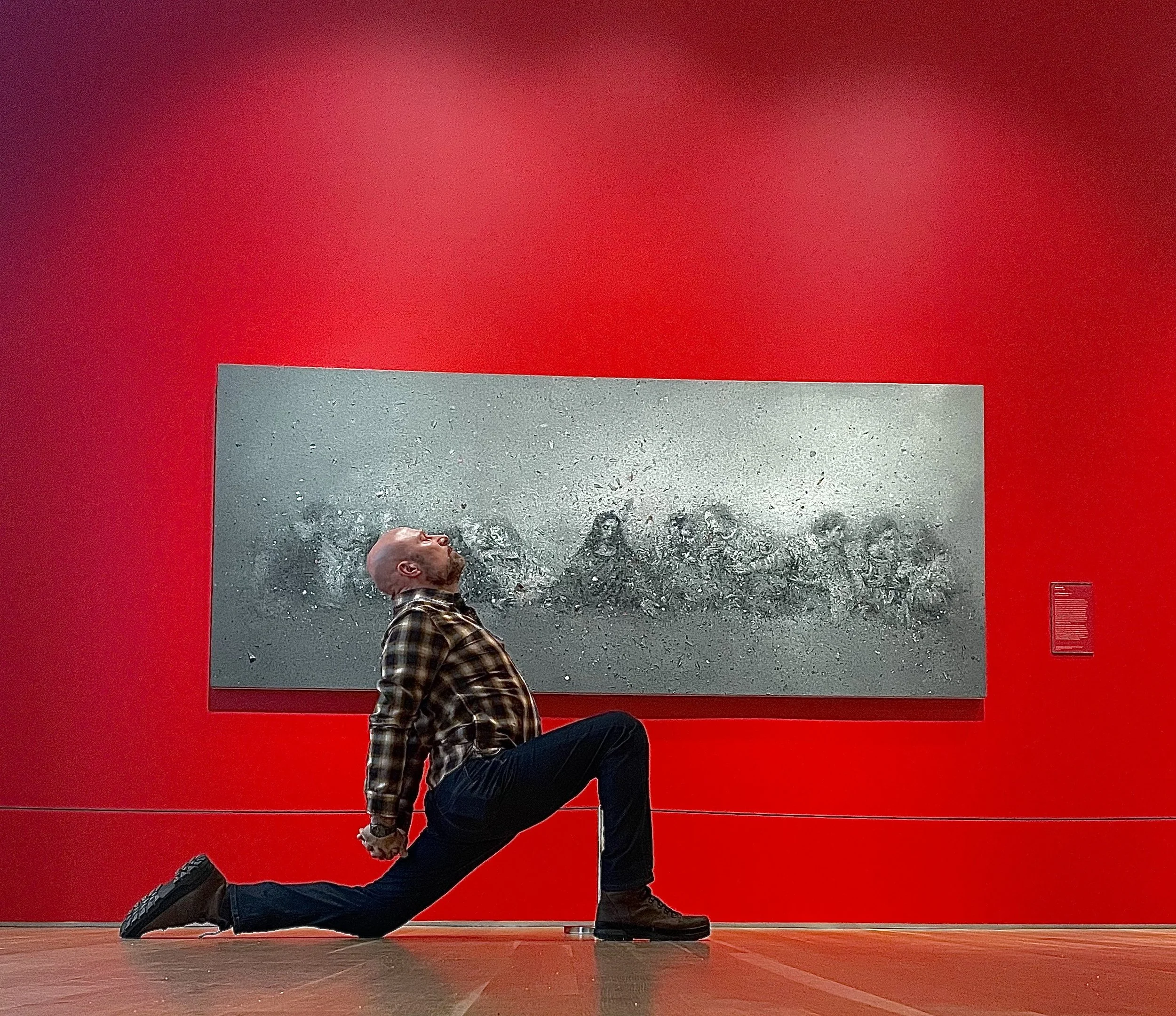
That’s the effect of a yoga class taught by Steve Krojniewski – or “Yoga Steve,” if you’re talking to one of his regulars. You can usually find him leading yoga in Studio 4 of the Duncan Smith Center; this is the sanctuary where he provides students and faculty a reprieve from the busyness of campus life. 

Krojniewski has changed into normal clothes by the time we sit down for our interview – apparently even yogis have to wear shoes in public. We sip on cups of Hagerty coffee as I try to unlock the secret to his perpetual calm demeanor.

“I’m human too,” he laughs. “It’s been a hard road, right? Yeah, [there’s been] a lot of ups and downs.”

The yogi is likely remembering his late mother, Carol Krojniewski. She was diagnosed with cancer when Steve was just eleven years old, passing away a year later and leaving him with his sisters and dad.

In the aftermath, the young Krojniewski sought refuge where he’d always found it: the St. Joseph River. The banks of the winding river were a regular hangout spot for him and his friends, but drawn to the sound of its running water, Krojniewski increasingly found himself going there alone when he needed an escape.

“I could sit and be still and feel safe. I felt like I had a healing experience there every time I would go,” he explains. Unbeknownst to him, the young Krojniewski was learning a practice that would become central to his future career: how meditation could be a grounding force. 

But at the same time, another passion was developing – one quite different from meditation.

“Right after my mom passed, my dad was like, ‘Well, what do you want? What can I get for you?’” he says. Krojniewski’s answer? 

A drum set.

Little did I know that most people know him not as “Yoga Steve,” but as “Krojo” the drummer. 

Krojniewski’s interest in music stems from years spent in his basement listening to his parents’ records. When his dad agreed to buy him a drum set, he and his neighbor decided to start their own band. “The Mushroomhead Experience” began to put on concerts in the living room whenever his neighbor’s parents left for the weekend. 

It wasn’t uncommon for hundreds of locals from their school – from the baseball team to the theatre kids  – to show up. People would spill into the backyard as Krojniewski’s dad sat right across the street, supporting from a distance.

“It was a way of bringing people together who wouldn’t normally hang out. We [were] always trying to create this safe space, right? How can you bring all those people together, have everybody get along, and get to understand each other?”

Today, Krojniewski proves that yoga and drumming aren’t so different, after all. As the lead yoga sports coach at Notre Dame for 20 years now, Krojniewski has brought yoga to nearly every corner of campus – from the football team to trauma survivors at St. Liam’s – while still finding time to create original music for rock lovers.

At the heart of both passions is getting to share what saved his own life. For Krojniewski, yoga and drumming weren’t just hobbies; they were survival mechanisms during years of depression, clinical diagnoses and emotional instability. 

In an era when national studies report a mental health crisis on college campuses and Notre Dame’s Wellness Center tackles record demand, Krojniewski offers something rare: not a productivity hack or a downloaded wellness app, but the quiet work of showing up to practice. Practicing how to ground yourself, day after day, even when everything else feels unmoored.

Creating spaces for people to do this has become his life’s mission: “When I come here, it’s not about me anymore. I walk into that classroom [or stage] and it’s: how do I serve you?” It’s the only way, he believes, people can connect with their most authentic selves and inspire others to do the same. “I want to teach people to be original. Because if you're thriving … then whoever you show up for is going to thrive.”

Young Krojniewski couldn't have predicted how the St. Joseph River would launch a career where he’d touch so many lives. But perhaps that’s the point: Healing is rarely a linear process. For Steve, it started as survival, became practice and – through his own commitment – transformed into service. 

A ripple effect that my mind, muscles and ears alike are grateful for.

Allison Elshoff

Allison Elshoff is a senior business analytics major with minors in the Hesburgh Program of Public Service and impact consulting. Her top three things to exist are hammocks, outfit repeating and mini spoons. You can reach her at aelshoff@nd.edu.

2 Comments

Comment

Yoga For The Holidays

It’s that time of year again—the holidays. We contemplate and show gratitude for everything we have: our family, friends, a home over our heads, and enough money in our accounts to spend on the people we love. However, it is also a time of year when stress levels can swell for many individuals.

 The American Psychological Association reports that around forty-three percent of individuals disclose an increase in stress during this time. This means that nearly two-fifths of adults feel the mental and emotional strain of the holidays. It’s no secret that when people feel stressed, it can lead to depression, anxiety, and physical illness. What is even more shocking is that women, by two to one against males, are more likely to feel the burden of the holidays.  Though people will look to ease this stress by talking to family or friends, there is another way to combat the stress: doing yoga. When you add a consistent yoga practice during the holidays, individuals can decrease stress and anxiety dramatically. Studies have shown that yoga can increase serotonin, “the feel-good hormone,” to improve your mood and enjoy the holidays. Yoga also increases gamma-aminobutyric acid (GABA), which is associated with better mood and decreased anxiety. Adding a yoga practice to your life will address much-needed self-care this time. That way, you can enjoy the season without feeling overwhelmed by the holiday buzz. It's important to acknowledge that holiday stress is a common experience, and you are not alone in this. 


Here is a yoga sequence to help you decrease stress and anxiety and assist you with the season. I encourage you to give it a try and see how it can positively impact your holiday experience

Comment

Comment

Yoga For Catchers

What is one of the most challenging positions in both baseball and softball? The catcher. Think about it. A catcher has to squat for most of their time on the diamond. They must be able to throw out base runners from the squatting position or on their knees. They are responsible for scouting and developing a strategy for every at-bat and pitch sequence against opposing hitters. A catcher is an on-field general who informs and realigns their teammates against each batter. They must be leaders and selfless for the team's good. 


The catcher's role is so crucial that they must possess a high pain threshold to always be on the field. The muscles that catchers use in their position are the glutes, hamstrings, pectorals, and rotator cuffs, to name a few. They must also have enough mobility in their ankle joints to improve and sustain their movements throughout every game.

This is where strength training comes into play. Catchers must maintain the everyday grind of 

their position. 

Are there any other ways that catchers could improve their overall training? There is one. It is yoga.

More teams could incorporate yoga to help catchers increase their flexibility and mobility to perform at their peak potential. Not only does yoga help create more flexibility and mobility for catchers, but it will also increase focus and concentration. It will raise a more profound awareness and allow a catcher to change strategies in a moment if needed.

Here is a sequence that targets the ankles, hips, hamstrings, and shoulder girdle to assist catchers in performing at their best.

.

Comment

Comment

Yoga For The Shoulders

Have you ever considered the silent heroes of your body, your shoulders? They work tirelessly, yet we often overlook them. Let's take a moment to appreciate their role, especially when seated at a desk or engrossed in our work. 

Most of us overlook our shoulders and their positioning until we start experiencing tension. However, by the time we pay attention, we might already have an injury due to our neglect of proper shoulder alignment. This could have been prevented if we had been more mindful of our bodies, underscoring the importance of shoulder health.


It's crucial to understand that many shoulder injuries result from poor posture. We often find ourselves slumped over a computer at work, standing with a rounded back, or simply sinking into a chair. These habits can lead to severe health issues, highlighting the necessity of maintaining good posture.  


The Mayo Clinic has reported that poor posture can lead to shoulder impingement. The National Library of Medicine studied whether poor posture contributed to tears in the rotator cuff muscles. They found that Postural abnormality increased the risk of tears to either one or both sets of the rotator cuff muscles. 


So, that begs the question: How can we decrease the chances of a shoulder injury due to poor posture? 


Here's a simple yet effective way to combat slumping: sit or stand straight and roll your shoulders down your back. This minor adjustment can make a big difference in maintaining proper posture and preventing shoulder injuries.


Strengthening the shoulder girdle muscles is another effective way to enhance your posture and shoulder health. These muscles play a crucial role in maintaining shoulder stability and posture, and by strengthening them, you can significantly reduce the risk of shoulder injuries.


What are the shoulder girdle muscles? Well, they are broken into 3-parts;


  • The Muscles of the Scapula. These muscles originate from the skeleton and insert into the scapula, including the trapezius, levator scapulae, rhomboids, and serratus anterior.

  • The Rotator Cuff Muscles. These muscles originate from the scapula and insert into the tuberculum, stabilizing the glenohumeral joint. The four rotator cuff muscles are the supraspinatus, infraspinatus, teres minor, and subscapularis.

  • The Primary Movers of the Upper Arm. These muscles originate from the clavicle and scapula and insert into the humerus, including the biceps, deltoid, and triceps.


Now that we know these muscles, let’s work on strengthening them. Them. Here is a yoga flow designed to help stabilize the shoulders and improve posture.


Comment